



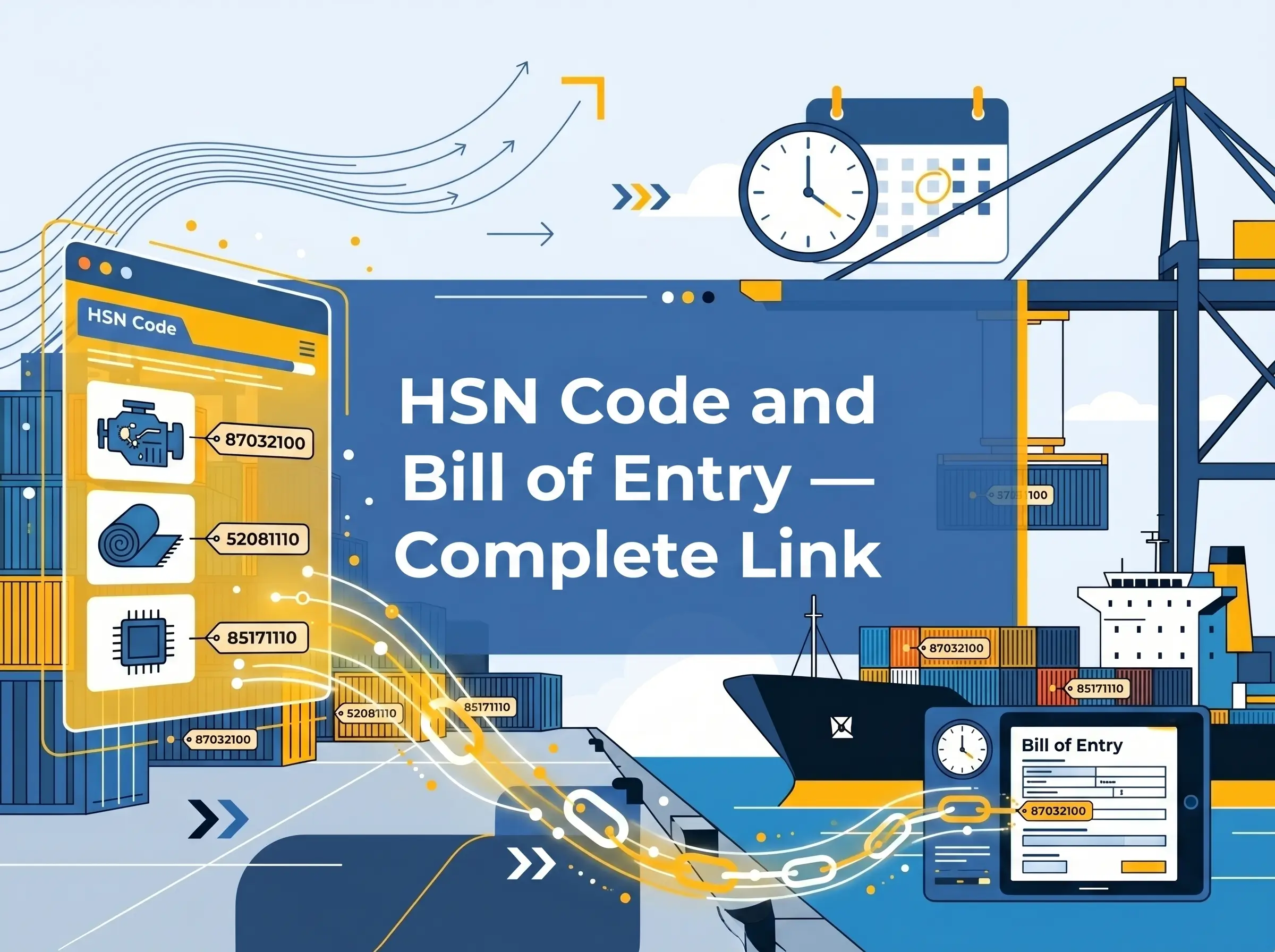
The HSN code (Harmonized System of Nomenclature) on your bill of entry is arguably the single most important field in the entire document. It determines your customs duty rate, IGST rate, applicable exemptions, and even whether your goods can be imported at all. Getting it wrong — even accidentally — can cost lakhs in excess duty or trigger serious customs penalties.
What Is an HSN / HS Code?
The Harmonized System (HS) is an internationally standardized system for classifying traded goods, maintained by the World Customs Organization (WCO). India uses an 8-digit HSN code for customs purposes:
| Digits | Level | Example (Smartphones) |
|---|---|---|
| First 2 digits | Chapter | 85 (Electrical machinery) |
| First 4 digits | Heading | 8517 (Telephones) |
| First 6 digits | Subheading (international) | 851712 (Smartphones) |
| All 8 digits | National tariff item (India) | 85171200 (Smartphones) |
The 8-digit code on your bill of entry must match the CBIC Customs Tariff Act classification for your specific goods.
How the HSN Code Drives Duty on Your BoE
Once the HS code is determined, the following rates are automatically applied:
- Basic Customs Duty (BCD): Varies from 0% to 150% by HS code
- Social Welfare Surcharge (SWS): 10% of BCD
- IGST: 5%, 12%, 18%, or 28% depending on the GST council rate for the HSN code
- Cess (if applicable): For tobacco, luxury cars, aerated drinks — additional cess applies
- Anti-dumping / Safeguard / Countervailing duty: Triggered by specific HS codes for specific origin countries
HSN Code vs HS Code vs ITC-HS — What's the Difference?
| Term | Digits | Used For |
|---|---|---|
| HS Code (WCO) | 6 digits | International trade / WCO standard |
| HSN Code (India GST) | 4–8 digits (8 for imports) | GST invoicing and BoE filing |
| ITC-HS Code | 8 digits | India's import/export policy (DGFT) |
| Schedule 1 (Imports) | 8 digits | Customs tariff — duties on imports |
All of these trace back to the same 6-digit international HS code but may differ at the 7th and 8th digit for national classification.
Top 10 Most Common HSN Errors on Bill of Entry
- Using 6-digit code instead of 8-digit — Indian customs requires 8 digits; 6-digit entries are rejected
- Mis-classifying finished goods vs components — a finished product assembled abroad in packaging may classify differently than its components
- Using the GST HSN from invoice without customs validation — supplier's invoice HSN is a starting point, not final; customs may reclassify
- Confusing Chapter 84 and 85 — machinery (84) vs electrical equipment (85) is a common grey area
- Wrong sub-heading for chemical formulations — chemicals often have highly specific subheadings with wildly different duty rates
- Missing specific HS for blended products — multi-component products may classify by principal ingredient rule
- Using the origin country's HS code directly — HS codes can differ at 8-digit level between countries
- Not checking for restricted goods under ITC-HS — some HS codes are under "Restricted" category requiring import license from DGFT
- Ignoring anti-dumping notifications — specific HS codes for goods from specific countries attract additional anti-dumping duty
- Selecting wrong unit of measurement — some codes require KGs, others pieces, others litres; mismatch causes valuation errors
How to Find the Correct HSN Code for Your Import
- Start with the product description: What is it, what is it made of, what is it used for?
- Check the CBIC Customs Tariff — available at cbic.gov.in — search by keyword or browse chapters
- Use the GRI (General Rules for Interpretation) of the HS — these 6 rules determine how to classify goods when classification is ambiguous
- Review CBIC rulings: The AAR (Authority for Advance Ruling) has published thousands of rulings on specific products
- Consult your CHA — experienced CHAs know common classifications at their port and can advise on grey-area goods
- Apply for Advance Ruling (under Section 28H of Customs Act) if you have recurring imports and classification is uncertain — ruling is binding on customs
Consequences of Wrong HSN Code on BoE
| Scenario | Consequence |
|---|---|
| Under-classified (lower duty rate used) | Demand for differential duty + 15% interest p.a. + possible penalty up to 100% of duty |
| Over-classified (higher duty rate used) | Excess duty paid — can claim refund under Section 27 within 1 year |
| Restricted goods (Free → Restricted category) | Confiscation possible; import license required retrospectively |
| Anti-dumping triggered | Additional anti-dumping duty demanded for goods from specific countries |
| GST HSN mismatch vs Customs HS | ITC disallowance; reconciliation required with GST officer |
Frequently Asked Questions
Can I use the supplier's HSN code on my bill of entry?
You can use it as a starting reference, but you — or your CHA — are legally responsible for the correct classification in India. The supplier's code (from their country) may differ at the 7th and 8th digit. Always verify against the Indian Customs Tariff.
What is an Advance Ruling for HS code?
An Advance Ruling (under Section 28H of the Customs Act) is a formal binding decision from the Customs Authority on how a specific product should be classified. It gives importers certainty before large-scale imports. Applications are filed with the Authority for Advance Rulings (Customs).
My CHA filed the wrong HS code — who is responsible?
The importer is legally responsible under customs law — the CHA acts as your agent. However, if you provided correct product information and the CHA made the error, you can claim damages from the CHA under your service agreement. Always review the BoE draft before filing.
Related: HS code classification reference · How to amend a BoE · India customs hub · Types of bill of entry
Comments (0)
No comments yet. Be the first to share your thoughts!
Leave a comment
Your comment will appear after it's reviewed. Your email is never shown publicly.