



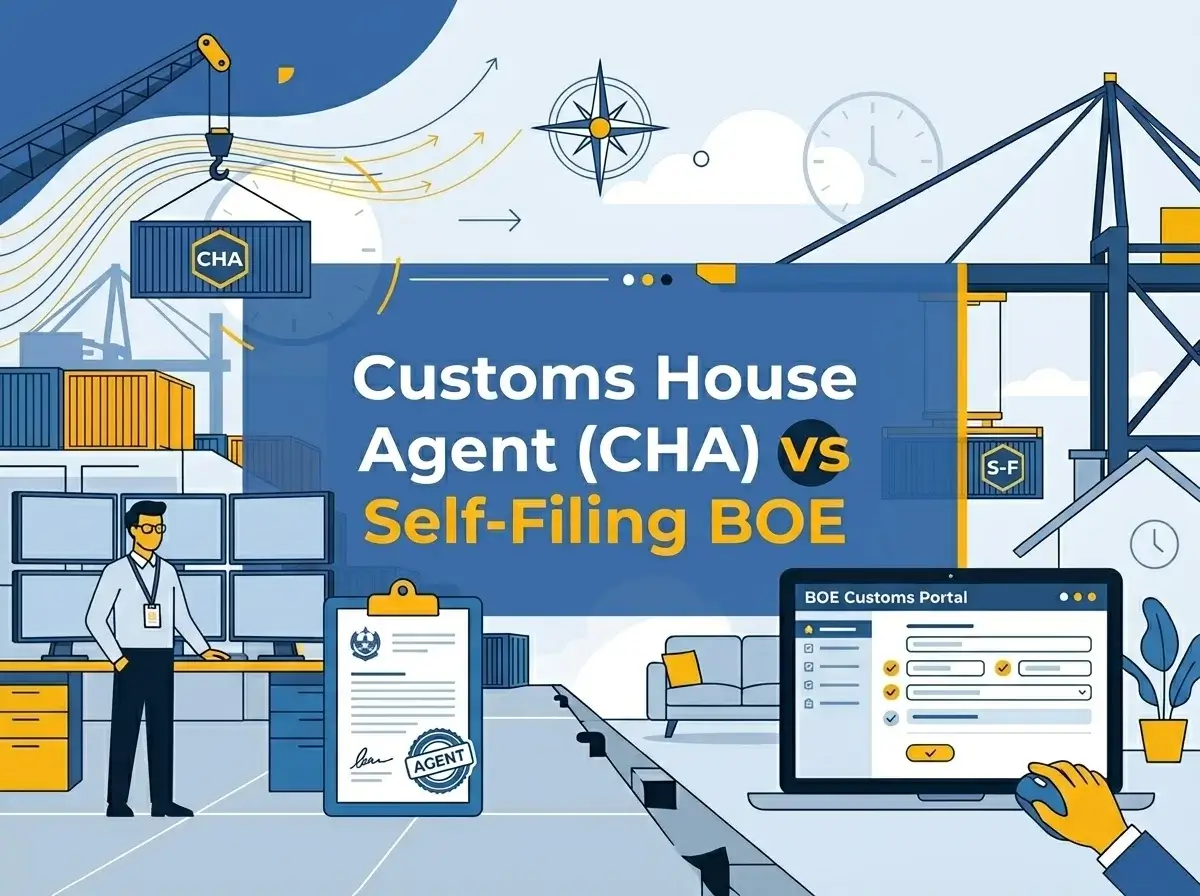
Every importer into India faces the same decision: hire a licensed Customs House Agent (CHA) or build the capability to file the bill of entry yourself on ICEGATE? The right answer depends on your import volume, product complexity, internal resources, and risk appetite. This guide gives you the full comparison.
What Is a Customs House Agent (CHA)?
A CHA (also called a Customs Broker under the Customs Brokers Licensing Regulations, 2018) is a licensed professional authorized to transact business with Indian customs authorities on behalf of importers and exporters. They hold a G-Card or F-Card credential issued by CBIC, and their license is renewed based on compliance and examination scores.
CHAs handle everything from filing the BoE on ICEGATE to coordinating with the port, responding to examination orders, arranging duty payment, and securing out-of-charge authorization.
What Is Self-Filing?
Importers can apply for direct ICEGATE access and file their own bill of entry without a CHA. This requires:
- Valid IEC (Import Export Code) from DGFT
- Registered AD code with your bank for customs purposes
- ICEGATE registration with a Digital Signature Certificate (DSC)
- In-house expertise in customs classification, valuation, and documentation
Full Comparison: CHA vs Self-Filing
| Factor | Using a CHA | Self-Filing |
|---|---|---|
| Setup required | Minimal — appoint CHA, share documents | IEC, AD code, DSC, ICEGATE registration |
| HS classification expertise | CHA provides (quality varies) | Must develop in-house |
| Cost per shipment | ₹3,000–₹25,000 service fee + disbursements | Staff time only |
| Speed at port | Usually faster (CHA has port relationships) | Depends on expertise level |
| Compliance risk | Shared (importer still liable) | Fully on importer |
| Error rate | Low (experienced CHA) | Higher without training |
| Best for first import | Strongly recommended | Risky without customs knowledge |
| Best for high-volume (50+ shipments/year) | Expensive long term | Cost-effective with trained staff |
| Sensitive/complex products | Specialist CHA recommended | Very difficult without expertise |
| Dispute handling | CHA assists with queries | Importer must handle directly |
What Does a CHA Typically Charge?
CHA fees are negotiated and vary by port, cargo type, and shipment complexity. Typical fee ranges in India:
| Service | Typical Cost |
|---|---|
| Basic BoE filing (sea, LCL) | ₹3,000–₹8,000 |
| Basic BoE filing (sea, FCL) | ₹5,000–₹15,000 |
| Air freight clearance | ₹3,000–₹10,000 |
| Courier clearance (low-value) | ₹500–₹2,000 |
| Complex / sensitive goods (pharma, chemicals) | ₹15,000–₹40,000+ |
| Amendment filing | ₹1,000–₹5,000 |
Plus disbursements: port charges, CFS charges, examination charges, transport — these are pass-throughs, not CHA profit.
When Should You Definitely Use a CHA?
- Your first import — the learning curve on ICEGATE is steep
- Importing regulated goods: pharmaceuticals, chemicals, food, electronics with BIS requirements
- Goods that frequently go to Red Channel (physical examination)
- High-value shipments where a classification error could mean lakhs in excess duty
- Goods with preferential duty (FTA) eligibility — requires correct origin certificate handling
- Time-sensitive cargo where clearance speed is critical
When Self-Filing Makes Sense
- You import the same product repeatedly (consistent HS code, supplier, value)
- You have 50+ shipments per year — CHA fees add up significantly
- You have a trained compliance team familiar with ICEGATE
- Your goods are low-risk, standard products (e.g., raw materials, standard components)
- You want full control over your customs data and record-keeping
Hybrid Approach: The Best of Both Worlds
Many experienced importers use a hybrid model:
- Use a CHA for the first 10–20 shipments of a new product to understand the classification and process
- Transition to self-filing once the team is trained and confident
- Retain the CHA on standby for complex queries, examinations, and amendments
How to Choose a Good CHA
- Verify their license is active on the CBIC CBLR portal
- Check their experience with your product category
- Ask for references from existing clients at the same port
- Get a clear written quote — separate CHA fee from disbursements
- Ensure they provide you with copies of all filed documents
- Avoid CHAs who promise "lower duty" through mis-classification — this exposes you to penalties
Frequently Asked Questions
Can a CHA file without the importer's knowledge?
No. CHAs are legally agents of the importer and must act on the importer's instructions with documented authorization (Power of Attorney). The importer remains legally responsible for all declarations made on the BoE.
If the CHA makes an error, who is liable?
The importer is primarily liable under customs law. However, you can pursue the CHA for damages under contract law if their negligence caused the error. Always maintain your own copies of all shipment documents.
Can I switch CHAs mid-shipment?
Yes, but it is complicated. You need to cancel the existing authorization and appoint a new CHA — possible but creates delays. Best done before the BoE is filed.
Related: How to file a bill of entry · Documents required · ICEGATE guide · Customs broker / CHA guide · India customs hub
Comments (0)
No comments yet. Be the first to share your thoughts!
Leave a comment
Your comment will appear after it's reviewed. Your email is never shown publicly.