



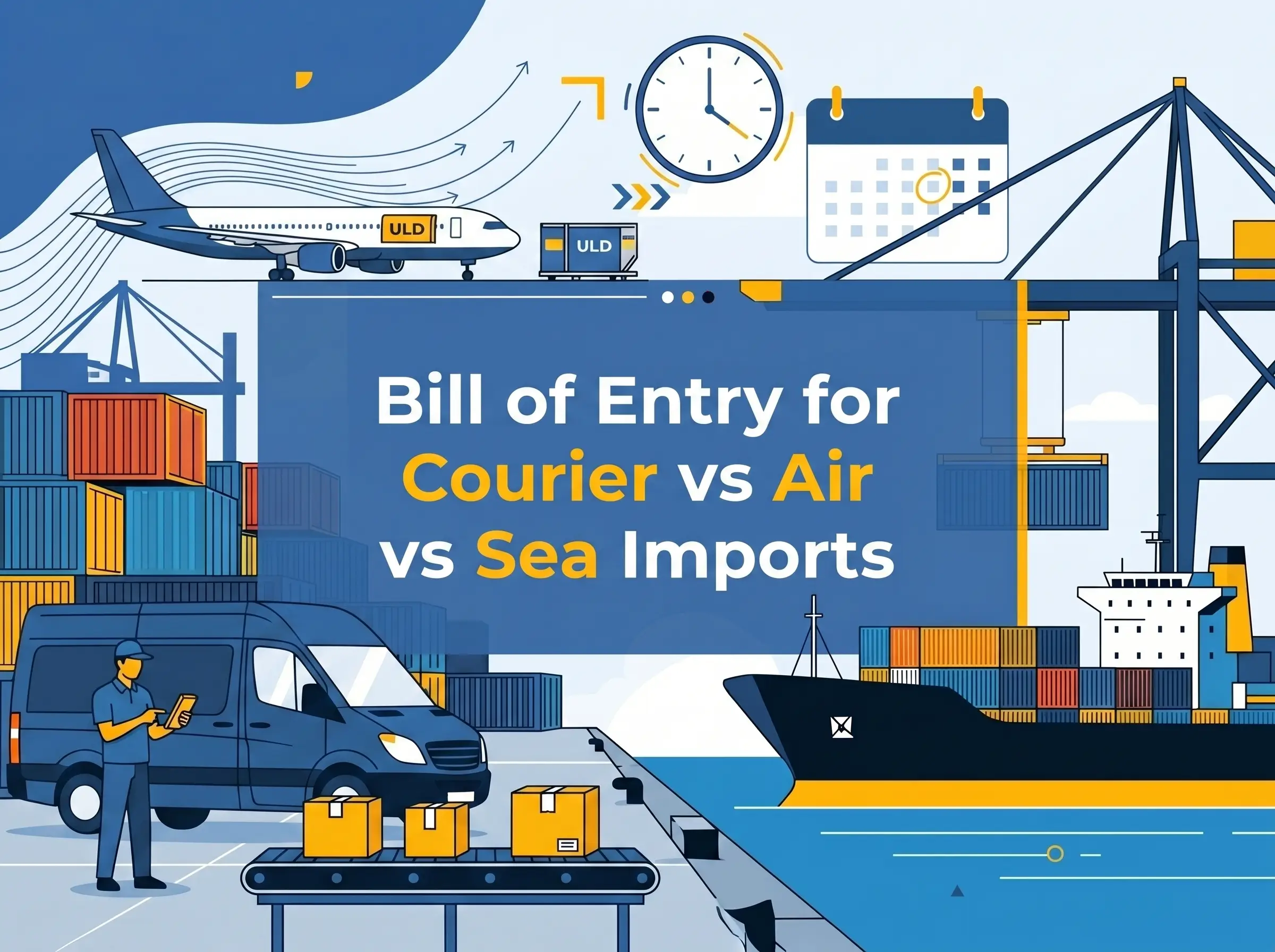
The bill of entry process in India is not the same for all import modes. Courier, air freight, and sea freight each have different filing channels, duty thresholds, clearance timelines, and documentation requirements. Choosing the wrong mode — or not knowing what to expect — can cost time and money.
Quick Comparison Overview
| Factor | Courier / Express | Air Freight | Sea Freight |
|---|---|---|---|
| Typical use case | Small parcels, samples, e-commerce | High-value, time-sensitive cargo | Bulk, heavy, or large-volume cargo |
| BoE type | Courier Bill of Entry (CBIT) | Air Freight Bill of Entry | Sea Freight Bill of Entry |
| Who files BoE | Express carrier (DHL/FedEx/UPS) or importer | CHA at air cargo complex | CHA at seaport / ICD |
| Filing document | Airway Bill (AWB) | Air Waybill (AWB) | Bill of Lading (BL) |
| Customs channel | Automated (below threshold) / Manual | RMS-based (Green/Yellow/Red) | RMS-based (Green/Yellow/Red) |
| Clearance time | 1–3 days | 1–3 days | 2–7 days |
| Duty threshold | ₹5,000 CIF = duty-free; ₹1L = formal BoE | All commercial values: formal BoE | All commercial values: formal BoE |
Courier / Express Imports — What's Different?
Express carriers like DHL, FedEx, UPS, and Aramex operate under the Courier Imports and Exports (Electronic Declaration and Processing) Regulations, 2010. Key differences:
- Below ₹5,000 CIF: No customs duty; simplified declaration only
- ₹5,001 to ₹1,00,000 CIF: Simplified courier BoE (filed by the courier company on your behalf)
- Above ₹1,00,000 CIF or regulated goods: Full formal BoE required; importer must be involved
- Courier BoEs are processed at dedicated Courier Terminals at international airports
- The express carrier acts as the CHA in most cases for shipments below the threshold
Documents for Courier Imports
- Commercial invoice from sender
- AWB / tracking number
- Packing list (for multi-item packages)
- IEC and GSTIN (for commercial imports above ₹1 lakh)
Air Freight Imports — Key Points
Air freight for commercial cargo (not through express/courier channels) follows the standard bill of entry process but with air-specific elements:
- Cargo arrives at the Air Cargo Complex (ACC) — at IGI Delhi, CSIA Mumbai, or other international airports
- The CHA must file the BoE and arrange clearance at the Air Cargo Customs office
- Goods are held at the Air Cargo Facility / Custodian (typically AAI or private operators like MIAL, DIAL)
- Storage charges at air facilities are high — typically ₹30–₹100 per kg per day after the free period (usually 2–3 days)
- Most air freight clears within 24–48 hours for Green Channel shipments
Documents for Air Freight Imports
- Air Waybill (AWB) — master and house AWB if via freight forwarder
- Commercial invoice
- Packing list
- Insurance certificate
- Certificate of Origin (if preferential duty applicable)
- Import license (for regulated products)
Sea Freight Imports — Standard Process
Sea freight is the most common mode for bulk and containerized cargo. The bill of entry process for sea freight is the standard process described on this site:
- Cargo arrives at major seaports: JNPT (Mumbai), Chennai, Mundra, Nhava Sheva, Kolkata
- The carrier files the Import General Manifest (IGM), which triggers the 24-hour BoE filing window
- Goods are held at the port / CFS / ICD — demurrage starts after free period (typically 3–7 days)
- Green Channel clearance: goods released within hours of out-of-charge
- Longest timelines if examination is ordered (Red Channel): 5–10+ days
Sea vs Air: When to Use Which?
| Choose Sea Freight If | Choose Air Freight If |
|---|---|
| Cargo weight > 100 kg | Cargo is time-sensitive (medical, seasonal) |
| Low urgency, lead time is flexible | High-value, low-weight goods |
| Raw materials, machinery, bulk goods | Electronics, fashion, perishables |
| Cost is the primary concern | Fast delivery is the priority |
Duty Implications by Mode
The duty rates are the same regardless of the mode of transport — BCD, SWS, and IGST apply based on HS code and value. However, the assessable value differs:
- Sea freight: CIF = Cost + Insurance + Sea Freight. Freight is often a smaller proportion of cargo value.
- Air freight: Air freight cost can be 5–10x sea freight — this increases CIF value and therefore the assessable value on which duty is calculated. For heavy goods, duty itself increases significantly.
- Courier: The AWB includes shipping charges paid — these form part of the CIF value for customs purposes.
Frequently Asked Questions
Can my courier shipment get stuck in customs?
Yes. If the declared value is incorrect, goods are restricted (e.g., supplements, electronics above BIS limits, certain food items), or documents are missing, the courier company will notify you that a formal BoE is required and your intervention is needed.
What is the import duty on courier shipments from abroad?
Gifts below ₹5,000 CIF are exempt. Above ₹5,000, duty applies at applicable BCD + IGST rates for the product's HS code. Courier companies often provide a duty estimate before you collect the parcel.
Do I need a CHA for air freight clearance?
For commercial shipments, yes — a CHA with accreditation at the relevant air cargo complex handles the BoE filing and airport clearance. The process is essentially the same as sea freight, just faster.
Related: Courier bill of entry guide · Air import customs clearance · Sea import customs clearance · India customs hub · How to file a bill of entry
Comments (0)
No comments yet. Be the first to share your thoughts!
Leave a comment
Your comment will appear after it's reviewed. Your email is never shown publicly.