

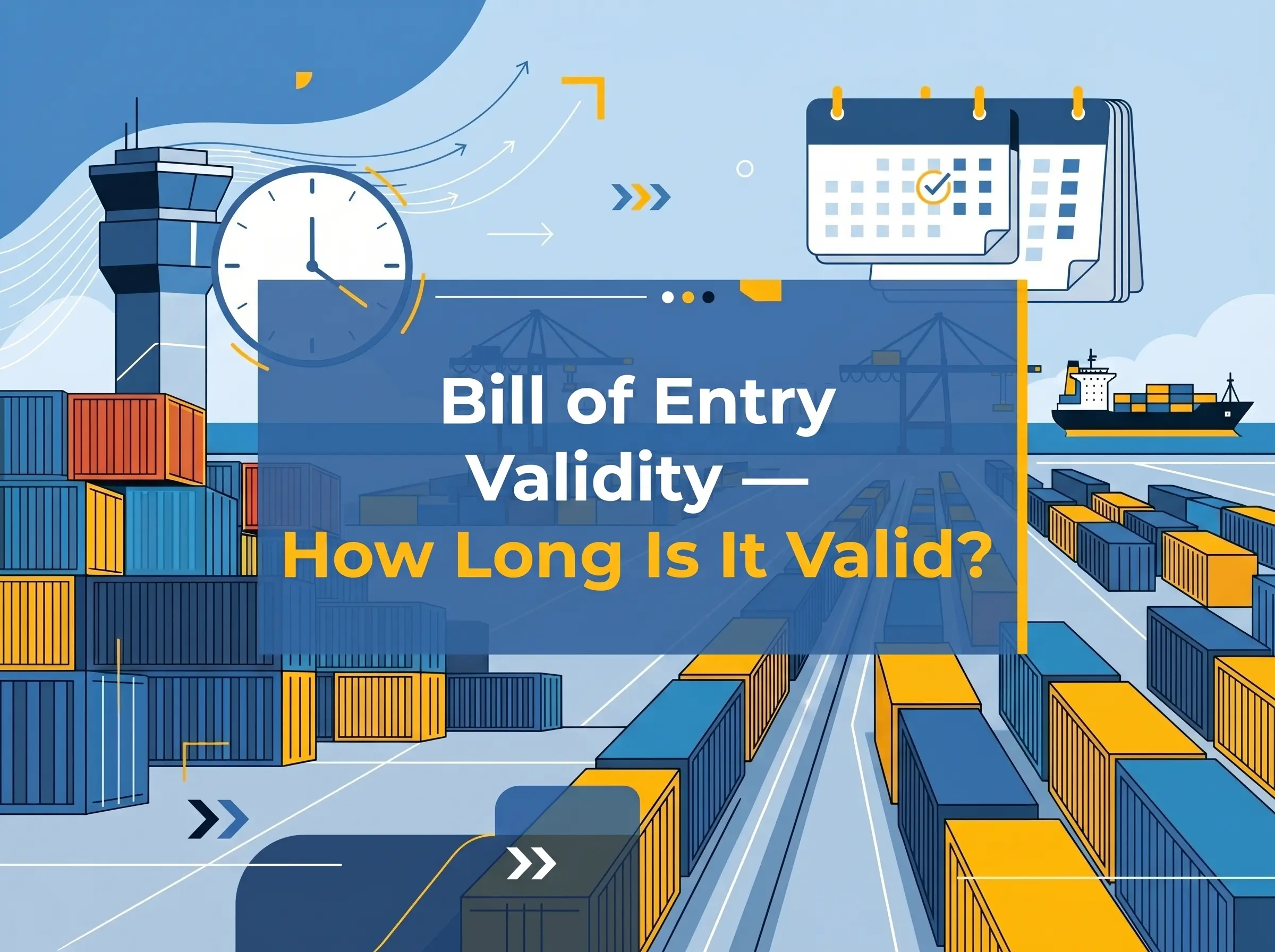
Many importers assume a bill of entry "expires" after a certain time — similar to a visa. The reality is more nuanced. Different aspects of the BoE have different validity periods: from the initial filing window to warehousing timelines and the finality of assessment. This guide clarifies each.
Does a Bill of Entry Have an Expiry Date?
A filed bill of entry does not have a single expiry date — but it is closely tied to specific timelines that govern what can be done at each stage:
Key Validity Timelines at a Glance
| Stage | Validity / Deadline | Consequence of Missing |
|---|---|---|
| Filing (advance BoE) | Up to 30 days before vessel arrival | Advance BoE lapses; refile on arrival |
| Goods assessment | Must be cleared within 30 days of arrival | Goods may be moved to Government Warehouse |
| Warehoused BoE | 1 year (extendable by Principal Commissioner) | Goods liable to auction if bond expires |
| Ex-bond BoE filing | Before warehousing period expires | Goods deemed abandoned |
| Amendment (Section 149) | Generally within 2 years of out-of-charge | Amendment rights lapse |
| Duty refund (Section 27) | 1 year from date of duty payment | Refund claim time-barred |
| Audit / re-opening | Up to 2 years (normal) / 5 years (fraud) | Customs can re-assess and demand differential duty |
Stage 1 — Filing Window (Before Vessel Arrival)
India allows advance filing of a bill of entry up to 30 calendar days before the vessel's expected arrival. This is strongly encouraged because:
- Duty assessment can begin before goods arrive, enabling faster clearance on arrival
- IGST and duty amounts can be pre-calculated and funds arranged
- RMS risk assessment happens in advance, improving chances of Green Channel
If the vessel does not arrive within 30 days, the advance BoE is cancelled and a fresh one must be filed.
Stage 2 — Clearance Timeline (Home Consumption BoE)
For a standard home consumption bill of entry:
- Once the BoE is filed, customs assesses it (usually within hours for Green Channel, 1–5 days for others)
- Duty must be paid within 2 working days of the assessment order (Out of Charge order)
- Goods can be released immediately after duty payment and port formalities
- If duty is not paid within 2 days, interest accrues at 15% per annum
Stage 3 — Warehoused Bill of Entry Validity
A warehoused BoE (filed when goods go into a bonded warehouse) has a specific period during which goods can remain in storage without paying duty:
- Standard warehousing period: 1 year from the date the BoE is filed
- Extension possible: The Principal Commissioner can extend for a further 1 year in genuine cases
- Capital goods: Can be warehoused for up to 3 years (subject to extension)
- Goods must be cleared via ex-bond BoE before the warehousing period expires
Stage 4 — Assessment Finality and Re-Opening
Once customs issues the "Out of Charge" order, the assessment is considered final — but not absolutely. Customs can re-open assessment in specific circumstances:
- Normal fraud/misdeclaration: Up to 5 years from the relevant date for cases involving fraud, collusion, or wilful misstatement
- Audit findings: CBIC audit teams can flag issues up to 2 years after clearance in normal cases
- Section 28 notices: Demand notices must be issued within the above limitation periods
Stage 5 — Refund Claim Validity
If you overpaid duty (due to classification error, valuation excess, or notification exemption not applied), you can claim a refund under Section 27 of the Customs Act. The time limit is 1 year from the date of duty payment — this is strictly enforced and courts have generally not condoned late claims without specific legal grounds.
Keeping Records for the Full Validity Period
Given that customs can audit up to 5 years after clearance, maintain the following for each BoE:
- Original BoE PDF (from ICEGATE)
- Commercial invoice, packing list, BL/AWB
- Duty payment challans
- Examination reports (if goods were examined)
- Any amendment letters and supporting documents
- Out-of-charge order copy
Frequently Asked Questions
Does a bill of entry "cancel" if duty is not paid?
Not automatically — but goods will remain in the port/warehouse and accumulate demurrage. After 30 days without clearance, customs may move goods to a Government Warehouse. After a further period, goods may be auctioned under Section 48 of the Customs Act.
Can I re-use a filed BoE for a second shipment of the same goods?
No. Each bill of entry is specific to one shipment, one consignment, and one Bill of Lading/AWB. A new BoE must be filed for every import shipment.
How long should I keep my BoE records for GST purposes?
The CGST Act requires retention of all GST-related records (including import BoEs supporting ITC claims) for 72 months (6 years) from the due date of the annual return for that year.
Related: Warehoused bill of entry · Ex-bond bill of entry · Track BoE status · Amend a filed BoE · BoE number format & lookup
Comments (0)
No comments yet. Be the first to share your thoughts!
Leave a comment
Your comment will appear after it's reviewed. Your email is never shown publicly.